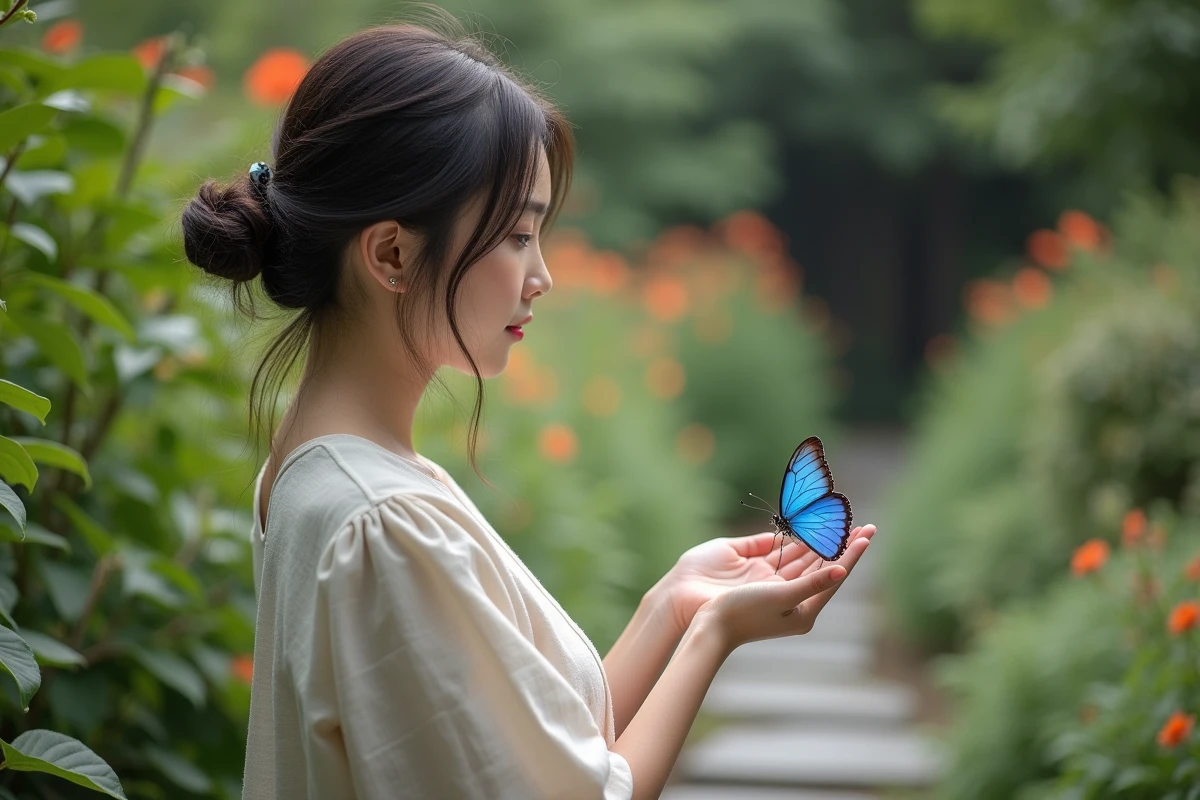
In some cultures, a shared symbol can embody opposing, even contradictory values, depending on the times or beliefs. The meaning of the same motif sometimes crosses borders, but it is not immune to local interpretations or religious or philosophical distortions.
The diversity of thought systems thus produces multiple, often surprising readings of the same natural phenomenon. This phenomenon affects both ancient myths and contemporary spiritual representations.
The blue butterfly: between fascination and mystery through the ages
In the animal kingdom, the blue butterfly immediately captures attention. Its almost electric brilliance, its unpredictable flight path: it never goes unnoticed. Among all lepidopterans, few evoke as much fascination. It’s hard to remain indifferent in the presence of the Morpho menelaus, famous for its wings of such intense metallic blue that it blurs the boundary between the tangible and the invisible. It’s impossible to cross its path without stopping for a moment.
Behind this palpable beauty lies a labyrinth of meanings, where history and spirituality intertwine. For those who wish to explore the meaning of the blue butterfly in traditions, several themes dominate: transformation, the promise of renewal, the passage from one state to another. In Asia, it is considered a good luck charm, almost a guarantee of a fresh start. In America, among many Indigenous peoples, it is sometimes a messenger, sometimes a protective guide. Observe its cycle: egg, caterpillar, chrysalis, adult. A spectacular metamorphosis, which takes on the value of initiation; each stage becomes the symbol of a possibility: to change, to evolve, to be reborn after trial.
Of course, butterflies of other colors also convey particular messages: the white embodies peace or purity, the red evokes passion or sudden transformation. Yet, blue occupies a unique space. So rare in nature, it seems condensed with hope, light, and mystery. It fascinates as much as it inspires. In the world of tattooing, in literature, or even on a canvas, it becomes an emblem of fragile beauty, of an inevitable change, of the urge to leave the ordinary. The blue butterfly represents persistent waiting and the desire for a flight into the unexpected.
Why is the blue butterfly a symbol of transformation and renewal?
It is impossible to overlook the message conveyed by the blue butterfly. It encapsulates the courage to transform. From a simple caterpillar to a winged silhouette, it undergoes a complete mutation that speaks to everyone. More than a passage from the biological to the marvelous, its flight embodies that inner strength that drives one to move forward, despite doubts or endless nights.
In many cultures, witnessing the emergence of the blue butterfly powerfully evokes the idea of spiritual rebirth. The chrysalis: a temporary retreat, imposing patience, but offering the possibility of rebuilding oneself. During this pause, potential prepares, and then the spectacle of flight signifies the abandonment of the old for a promise of light. The Morpho menelaus, with its metallic reflections, gives flesh to this idea of a threshold crossed, of a transition embraced towards a new page.
Here, in concrete terms, are the major dimensions related to this symbol that traverse many traditions:
- Inner transformation: the caterpillar-chrysalis-butterfly journey embodies progression, awareness, evolution.
- Hope and luck: due to its unique color, it carries promises of happy coincidences and renewal.
- Protection and guidance: according to some rites, the presence of a blue butterfly indicates discreet support or a direction to follow.
Its metamorphosis reminds us of a universal principle: no flight, no beauty comes without trial, without a time of silence or retreat. And it is precisely this passage that gives strength to the message of the blue butterfly, uniting hopes and desires for a better future across all cultures.

Spiritual messages and inspirations of the blue butterfly in the major traditions of the world
It is impossible to deny the strength with which the blue butterfly has slipped into the most significant stories and rituals here or elsewhere. In Greek mythology, it evokes Psyche, the personification of the soul capable of rebirth and lightness, even after traversing the shadow. The story of Psyche and Eros anchors the butterfly in the realm of intimate quest and fulfillment after trial.
In China, the symbolism is different: it expresses the joy of the couple, the aspiration for fidelity, the wish for long-lasting harmony. It can be found embroidered on festive clothing, painted on porcelain bowls. Among the Native Americans, it takes the form of a totem animal: messenger, bearer of a sign, a little wink from the invisible world. Sometimes, crossing its flight is perceived as a green light to dare to transform or to await a happy outcome.
Whether in Christianity, where it serves as a sign of resurrection, or in Buddhism, which sees it as the victory of spirit over matter, the blue butterfly traverses beliefs without ever losing its intensity. Its messages vary, but they often converge, between:
- affirmed rebirth after adversity,
- regained trust and hope for the future,
- reminder of the fleeting, and precious, nature of beauty.
Its appearance in a dream, on the skin, in a book, or by chance during a walk never leaves one indifferent. The blue butterfly asserts itself as a vibrant and universal force, a witness to freedom, resilience, and a silent hope that endures, even when everything seems still.