A linden tree planted two meters from a facade, a silver maple whose roots lift the terrace after ten years: these situations are seen every summer during drought episodes. Before planting a tree near a house, the distance to be respected depends less on a single rule than on the intersection of soil type, the chosen species, and local regulations. Confusing the legal distance from the neighbor with the safety distance for foundations remains the most common mistake.
Clay soil and heatwave: the real risk factor for foundations
It is often thought that roots crack foundations due to mechanical pressure. In reality, on clay soil, it is mainly the drying out of the soil caused by the tree that creates the danger. The tree draws water, the soil shrinks, and the foundation loses its support.
Heatwave episodes amplify this phenomenon. A dry summer is enough to cause differential shrinkage under a foundation footing if a water-hungry tree is too close. This is an angle that many guides overlook: drought exacerbates cracks much more than typical root growth.
On well-draining sandy or limestone soil, the risk is significantly lower. Before any planting, it is better to know the nature of your land. A simple test is to wet a handful of soil: if it forms a sticky ball, you are probably dealing with clay.
The type of soil conditions all reasoning when you want to plant a tree near a house without risking cracks.
Legal distance between neighbors and technical distance: two distinct logics
The Civil Code (articles 671 and 672) imposes 2 meters from the property line for a tree intended to exceed 2 meters in height, and 0.50 meters for shorter plantings. This rule concerns neighboring properties, not the protection of your own house.
The technical distance, the one that protects foundations, is often greater. For species with high water consumption (poplar, willow, silver maple), recent sources recommend between 10 and 15 meters from the facade. For an average tree (birch, red maple), we are talking more about 5 meters. For a small tree (serviceberry, lilac), 3 meters is generally sufficient.
Local urban planning regulations: to check before digging
Some municipalities impose specific distances through their local urban planning plan, which may be stricter than the Civil Code. It is recommended to consult the urban planning department of your town hall before planting, especially in subdivisions where boundary rules are sometimes reinforced.
Species with high water consumption: those that pose the most problems
Not all species present the same risk. The determining criterion is the amount of water the tree extracts from the soil and the extent of its root system.
- The poplar and willow are the most problematic: spreading roots, very high water consumption, ability to penetrate pipes and drains.
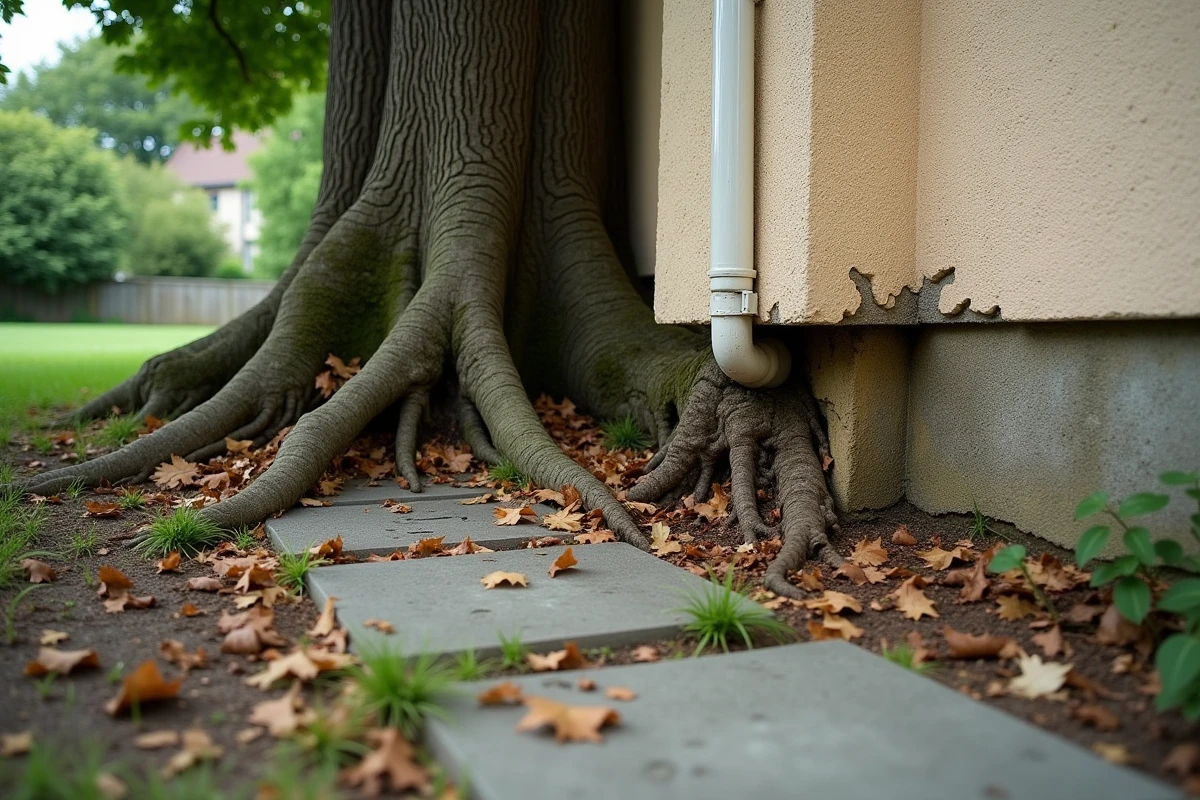
- The silver maple develops a superficial and extensive root network that easily lifts slabs, terraces, and sidewalks.
- The red oak, despite its slow growth, reaches a wide root development that requires significant setback from any construction.
Conversely, some species with taproot or compact rooting (strawberry tree, Indian lilac, certain dwarf fruit trees) adapt well to small gardens close to a dwelling, provided a minimum distance of 2 to 3 meters is respected.
Root barrier and selective pruning: act after planting
When the tree is already in place and cannot be moved, two solutions can help limit damage.
The root barrier is a polypropylene membrane buried vertically between the tree and the building, at a depth of at least 60 to 70 centimeters. It diverts the roots downward and prevents them from progressing toward the foundations. Its effectiveness depends on the quality of the installation: insufficient overlap at junctions allows fine roots to pass through.
Selective root pruning, performed by a professional, involves cutting those that are directed toward the house. This should not be done by oneself: a poorly placed cut can destabilize the tree or cause it to fall.
Monitor for signs before it’s too late
Feedback varies on the speed of disorder appearance, but certain signs should alert:
- Stair-step cracks on the facade, especially after a dry summer.
- Door or window that progressively gets stuck (a sign of structural movement).
- Localized sinking of a terrace or outdoor paving.
- French drain that recurrently clogs without visible cause.
If these signs appear, a geotechnical diagnosis can confirm whether the tree is to blame. Acting at the first signs of cracks costs much less than foundation underpinning.
The choice of a tree near a house is made at the time of planting, not ten years later. Knowing your soil, choosing a suitable species, and respecting a technical distance (not just legal) prevents most damages. On clay soil, it is better to plant too far than too close.