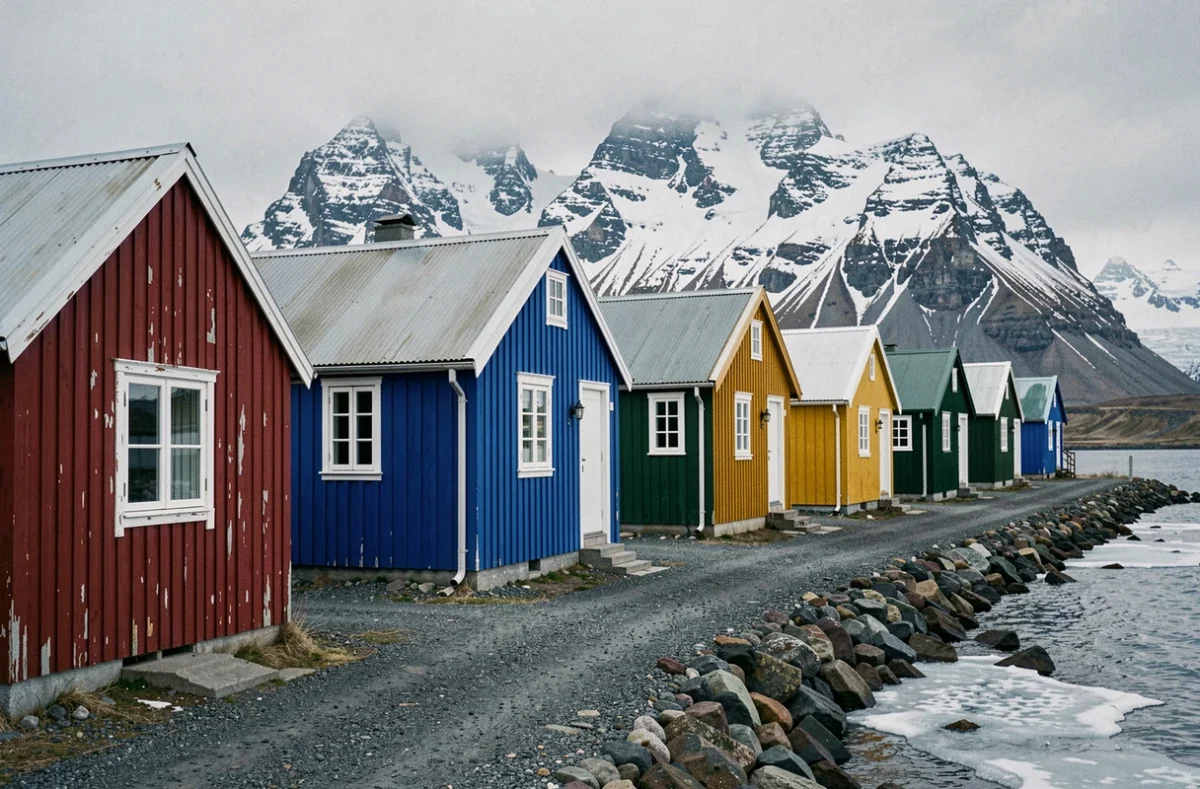
The colorful houses of Greenland catch the eye in every photo. Behind these bright facades lie heavy logistical constraints, a Danish colonial legacy, and technical adaptations to the polar environment. Understanding what determines the color of a Greenlandic house means measuring the gap between an outdated historical code and much freer contemporary choices.
Logistical constraints and imported materials in Greenland
Before the aesthetic question, one material factor conditions everything: construction wood arrives by boat, within very short maritime supply windows. Greenland has no exploitable forests. Every plank, every structural element must be transported from Scandinavia or other producing regions.
This dependence on imports explains why Greenlandic homes are largely made up of standardized or prefabricated elements. Construction sites are slowed down by the lack of specialized labor on-site and the brevity of the construction season. Exterior paint, easy to transport and apply, then becomes the main lever for individualizing a house whose structure is almost identical to that of the neighbor.
Before Danish colonization, the houses of Greenland were not painted wood: they were built from earth, canvas, or snow. The emergence of colorful facades coincides with the importation of the prefabricated Scandinavian model, which gradually replaced traditional Inuit housing.
Historical color code: correspondence between hue and function
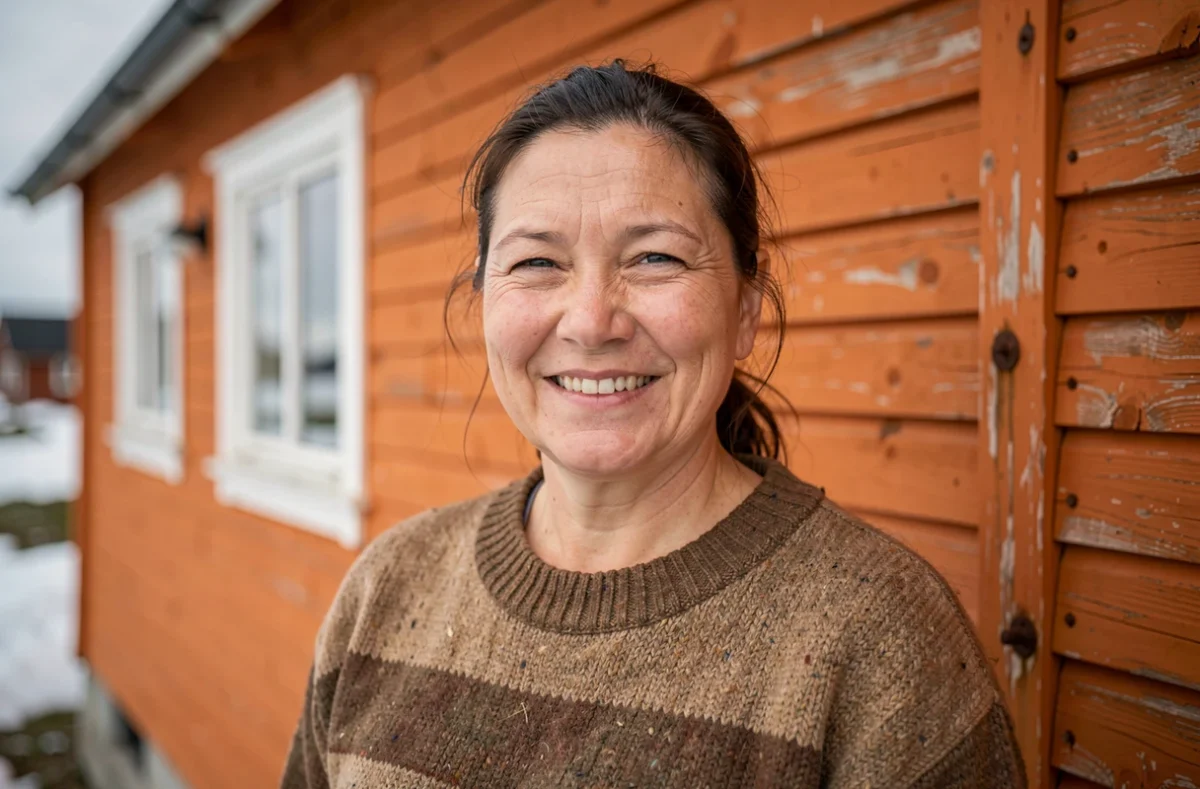
Danish colonists established a system where each color designated the function of the building or the profession of its occupant. This code facilitated orientation in often disastrous visibility conditions (snowstorms, prolonged polar night).
| Color | Associated historical function |
|---|---|
| Red | Administrative, commercial building, or school |
| Yellow | Medical personnel, care center |
| Blue | Activities related to fishing or maritime industries |
| Green | Telecommunications or technical services |
| Black | Law enforcement |
This table reflects the original logic, but this code no longer has regulatory value today. Residents now choose their hue more freely. The historical correspondence survives as urban memory, not as official signage.
Why the color code has lost its practical function
Several factors explain this gradual fading. Greenlandic localities have adopted modern signage (signs, numbering). Professions are no longer assigned to a single building. And the population itself claims an aesthetic freedom that the colonial system did not foresee.
This shift is significant: color now pertains to visual identity and collective memory, not to a regulation. A resident can paint their house yellow without engaging in any medical activity.
Placement and anchoring: color is only the visible surface
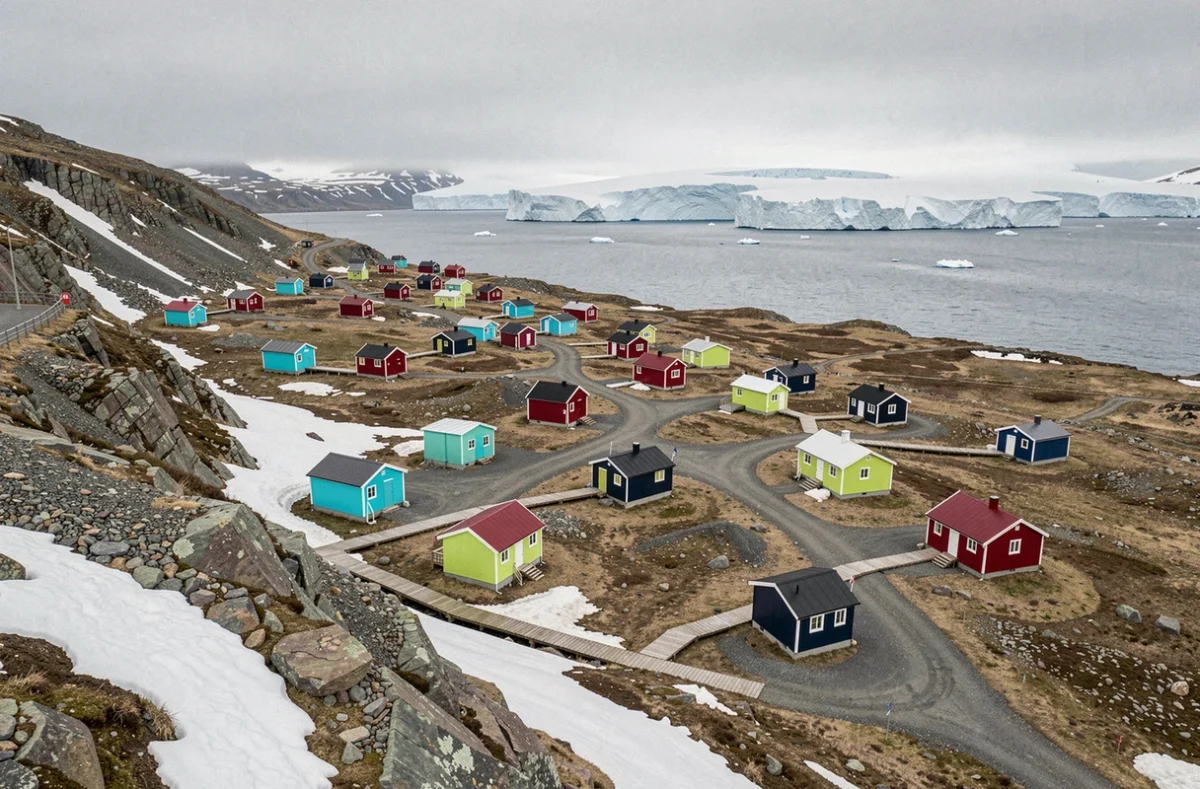
Reducing Greenlandic architecture to its colorful facades ignores what happens beneath. In several localities, buildings must be anchored in rock or installed on foundations suitable for frozen ground. Permafrost, rugged terrain, and strong winds dictate the placement of each construction.
Houses are often clustered tightly together to protect each other from the wind. Their orientation takes into account the local topography, not a classic urban planning scheme. In this context, bright color also serves a spatial identification function in a landscape where snow covers everything for months.
Foundations and rocky terrain: an underestimated technical challenge
Building on frozen ground imposes specific techniques. Foundations must avoid transmitting heat from the building to the permafrost, risking subsidence. Prefabricated, lightweight, and modular elements are favored precisely because they adapt to these constraints.
The standardization of structures makes painting all the more important as a marker of identity. When all houses share the same framework, color becomes the main visible distinguishing feature from a distance.
Colorful houses of Greenland: colonial heritage or local identity
The tradition of painted facades comes directly from Denmark and Norway. Scandinavian wooden houses have used natural pigments for centuries to protect wood and signal residences. Colonists transposed this practice to Greenland, adding the functional coding system.
Today, the colonial dimension of this tradition is being reappropriated. Greenlanders retain the bright colors but detach them from their imposed meaning. The palette remains a distinctive feature of the Greenlandic urban landscape, recognizable among all, and constitutes a major tourist attraction.
- Paint protects wood from moisture, frost, and UV rays, extending the lifespan of facades in a climate where maintenance is costly and complicated.
- Bright hues facilitate the identification of residences during the polar night and snowstorms, a function that remains relevant even without an official code.
- The choice of color has become an act of personal expression, transforming a colonial heritage into a marker of Greenlandic cultural identity.
The colorful houses of Greenland thus concentrate several dimensions into a single painted surface: technical protection of wood, identification in a hostile environment, memory of a vanished colonial system, and affirmation of local identity. The hue of a facade in Greenland is never just a matter of taste.