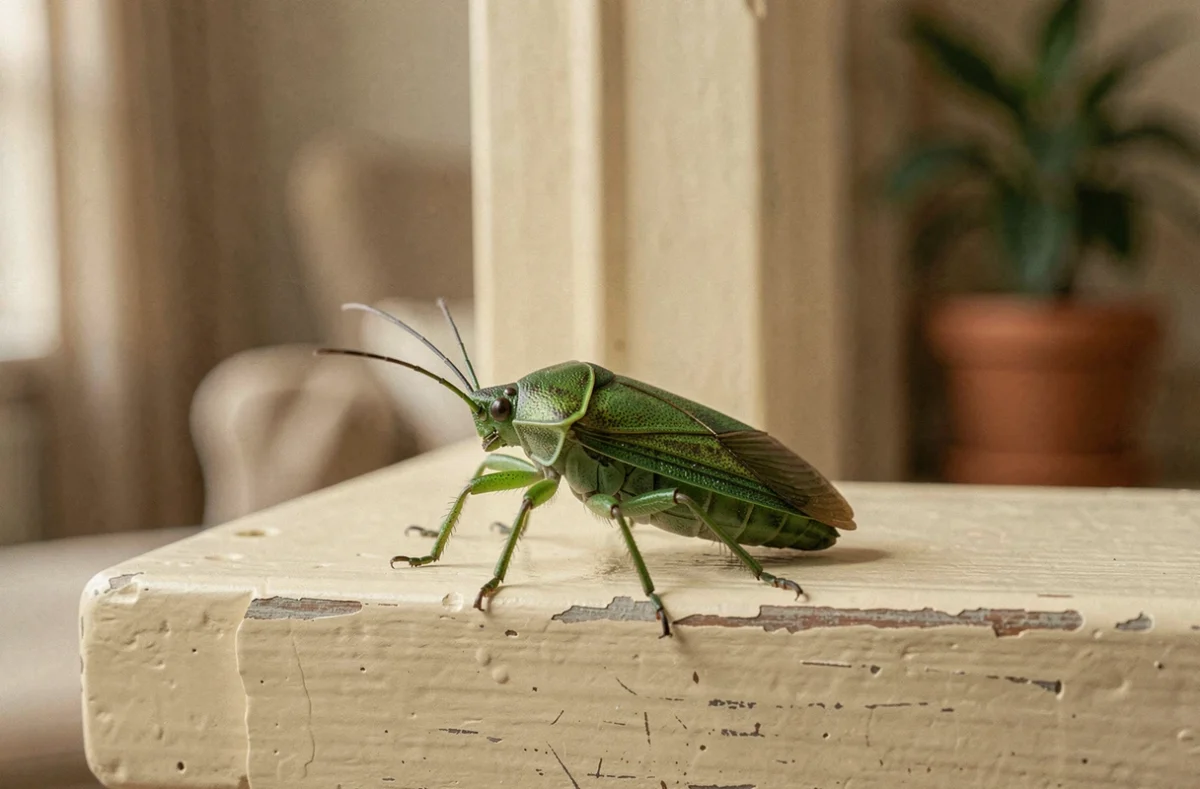
When a green bug appears on a wall or a windowsill, the reaction oscillates between curiosity and slight disgust. The insect is all the more intriguing as it does not resemble the usual pests. Its bright color, slowness, and characteristic odor make it a singular visitor, often laden with symbols in different traditions. Understanding what its presence reveals requires crossing two interpretative frameworks: one biological, the other symbolic.
Green bug: three distinct species behind the same color
The term “green bug” actually encompasses several species that are often confused. Before interpreting anything, it is essential to know which insect is actually in your home.
| Species | Scientific Name | Distinctive Visual Clues | Seasonal Behavior |
|---|---|---|---|
| Wood green bug | Palomena prasina | Uniform green, light green abdomen edge, thin antennae | Enters homes in autumn to hibernate, leaves in spring |
| Spotted green bug | Nezara viridula | Bright green with three small white dots aligned on the thorax | Seeks indoor warmth as temperatures begin to drop |
| Brown marmorated stink bug | Halyomorpha halys | Marbled brown (often confused when young with a green bug), striped antennae | Forms large aggregates on facades in autumn |
The color alone is not enough to identify the species. The antennae, head shape, and abdomen edge are more reliable criteria. This distinction has a direct practical interest: the brown marmorated stink bug causes agricultural damage that the other two species do not cause in the same proportions.
An article detailing the spiritual meaning of the green bug usefully complements this entomological approach with a symbolic reading.
Green bug in the house: what biology explains
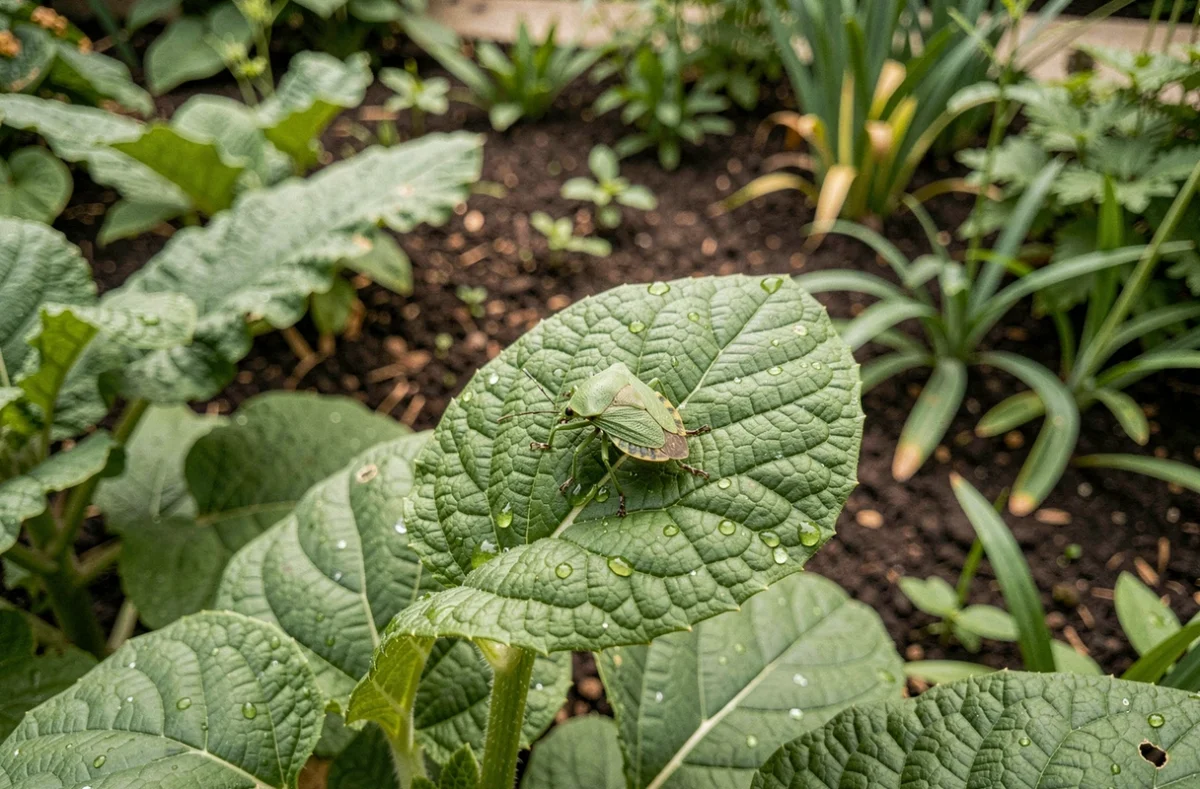
A green bug resting on a curtain or window frame usually does not signal an infestation. These insects live in gardens, hedges, and orchards and do not colonize homes. Their presence indoors corresponds to a well-documented seasonal behavior.
Why autumn concentrates observations
As temperatures drop, green bugs seek shelter to spend the winter. They slip through the gaps in windows, poorly fitting shutters, or vents. They do not reproduce indoors and spontaneously return outside in spring.
The impression of a sudden “invasion” often stems from specific meteorological and ecological factors. Populations vary significantly from year to year depending on temperatures, the availability of host plants, and the success of summer reproduction. A warm, humid year can multiply observations without the home itself being the cause.
Differentiating green bug and bed bug
The confusion between these two insects generates disproportionate anxiety. A few criteria allow for quick differentiation:
- The green bug is visible during the day, resting on a wall, window, or plant. It measures about one centimeter and emits a strong odor when threatened.
- The bed bug is nocturnal, brown, flattened, and much smaller. It leaves black marks (droppings) and blood spots on sheets.
- Repeated nighttime bites, grouped in lines or clusters, are a specific sign of the bed bug, never of the garden green bug.
A green insect on a wall during the day is not a bed bug. This distinction avoids costly and unnecessary treatments.
Symbols and cultural interpretations of the green bug
Beyond entomology, the green bug carries a symbolic weight in several traditions. These interpretations are not scientific, but they shed light on the fascination this insect exerts.
Renewal and natural cycle
The green color spontaneously associates this insect with vegetation, growth, and renewal. In some symbolic readings, encountering a green bug signals a favorable period for change or a new beginning. The fact that it appears in autumn, when nature slows down, reinforces this paradox: a symbol of vitality that emerges when everything seems to pause.
Protection and resilience
The green bug possesses a remarkable chemical defense mechanism. When it feels threatened, it releases a foul-smelling substance that repels most predators. This olfactory shield has fostered associations with personal protection and the ability to set boundaries.
Its resistance to external conditions, its ability to find shelter, and its capacity to survive winter without food also fuel a symbolism of patience and endurance.

Adaptation rather than strength
The green bug does not bite, does not sting humans, and causes no structural damage to homes. Its survival strategy relies on camouflage (its color makes it nearly invisible in vegetation) and chemical deterrence. Some traditions see this as a reminder that discreet adaptation can be more effective than direct confrontation.
Green bug at home: should you act or observe
The practical question always arises. The answer depends on the number of individuals and the discomfort felt.
One or two isolated specimens do not warrant any intervention. A glass and a sheet of paper are enough to move them outside without crushing them (crushing a green bug releases its characteristic odor, which lingers for several hours).
If entries are frequent, the problem is addressed upstream: check window seals, install screens, adjust shutters. Mechanical prevention is the only sustainably effective method against seasonal intrusions.
Whether one considers the biological reading or the symbolic reading, the green bug remains a transient insect. It does not settle, does not reproduce indoors, and leaves as soon as external conditions allow. Its presence provides more information about the state of the surrounding garden and the tightness of openings than about any “energy” of the home.