Two people who are 1.93 m tall can have radically different proportions: one may have a long torso and standard-length legs, while the other has a very long inseam and a short torso. Yet style guides for tall people tend to treat height as one uniform category. Dressing well when you’re over 1.90 m tall starts with identifying where your clothes are too short, then choosing a fit that corrects that specific mismatch.
Tall, long and regular fits: what the labels really mean
The term “tall” on a label doesn’t mean the same thing from one brand to another. Some brands simply add length to the inseam, while a true tall fit also adjusts the sleeves, torso and rise. That’s the difference between a “long” range, which adds a few centimetres along one dimension, and a “tall” range designed for the entire silhouette.
For someone over 1.90 m tall, the right choice therefore depends on where standard clothing falls short. A man with long legs doesn’t need a longer torso, and vice versa. Brands don’t all use the same height threshold for their tall ranges, so comparing your own measurements (inseam, sleeve length and torso length) with the brand’s size guide is more reliable than relying on the size label alone.
Several style tips for tall men make this point: sizing up to gain length also adds room around the shoulders and torso, throwing the silhouette out of balance.
| Body area | “Long” fit | “Tall” fit | Size up |
|---|---|---|---|
| Inseam | Lengthened | Lengthened | Little change |
| Sleeves | Unchanged | Lengthened | Wider and longer |
| Torso | Unchanged | Lengthened | Wider and longer |
| Shoulders | Unchanged | Adjusted | Too wide |
| Rise | Unchanged | Raised | Variable |
This table shows that the tall fit is the only option that adjusts several dimensions without adding unnecessary room. Sizing up is still a compromise that works only when your build calls for it.
Body proportions and fit: long legs, long torso, broad shoulders
Cameron Woki, a rugby player who is 1.98 m tall, explained in Le Figaro in October 2026 that slim-fit shirts rarely work for him. He sometimes chooses larger shirts and wears them open over a T-shirt. Another account cited in the same article, from a man who is 1.90 m tall, identifies trousers as the main challenge because of his long legs.
These two examples show why style advice needs to distinguish between leg length, torso length and build. Here are some adjustments for each body type:
- Long legs, standard torso: choose tall or long trousers with an extended inseam, but stick to a regular-size jacket or shirt so the upper body isn’t overwhelmed
- Long torso, standard legs: look for tall tops that are long enough to cover the waistband, while keeping regular trousers. T-shirts that ride up with the slightest movement are a common problem for this body type
- Broad build (shoulders and chest): sizing up can make sense for tops, provided you have the sleeves altered. A structured blazer with well-fitting shoulders is better than an oversized blazer that hangs straight down
Measuring a garment that already fits you well, then comparing those measurements with the size guide for the brand you’re considering, is the safest approach. Two people of the same height can have different proportions, making height-to-size charts unreliable.
Buying tall clothing: the problem of in-store availability
Tall ranges are often available online only. Physical stores tend to stock standard sizes, making it impossible to try items on before buying. This gap between online and in-store selections is a real obstacle for shoppers who are used to checking the fit in person.
To get around this, some strategies work better than others:
- Check the garment’s measurements (overall length, inseam and sleeve length) rather than the brand’s recommended height-to-size match
- Read reviews from shoppers who mention their own height and proportions, not just an overall rating
- Order two nearby sizes and return the one that doesn’t fit, making sure returns are free
The challenge is as much about finding the right fit as putting together a balanced outfit. Perfectly fitted tall trousers lose their impact if you choose the top at random.
Fabrics and finishing touches that flatter a tall silhouette
Beyond fit, fabric choice affects how a garment drapes on a tall frame. Sturdy fabrics (raw denim, heavy wool) help maintain the structure of a long garment. Fabrics that are too fluid or too thin tend to hang without shape, making the body look longer without adding structure.
Finishing details matter too. A hem that hits at the right point on the ankle changes the entire line of a pair of trousers. A sleeve cuff that ends right at the wrist creates a tailored look without complicated alterations. For shirts, checking that the shoulder seam sits on the shoulder bone (rather than below it) helps confirm that the size is right.
Contrary to popular belief, solid colours and subtle patterns are less visually elongating than vertical stripes. For someone who is already tall, the goal is to add structure to the silhouette, not make it look even longer. Contrasting blocks of colour between the top and bottom create a visual break that balances proportions.
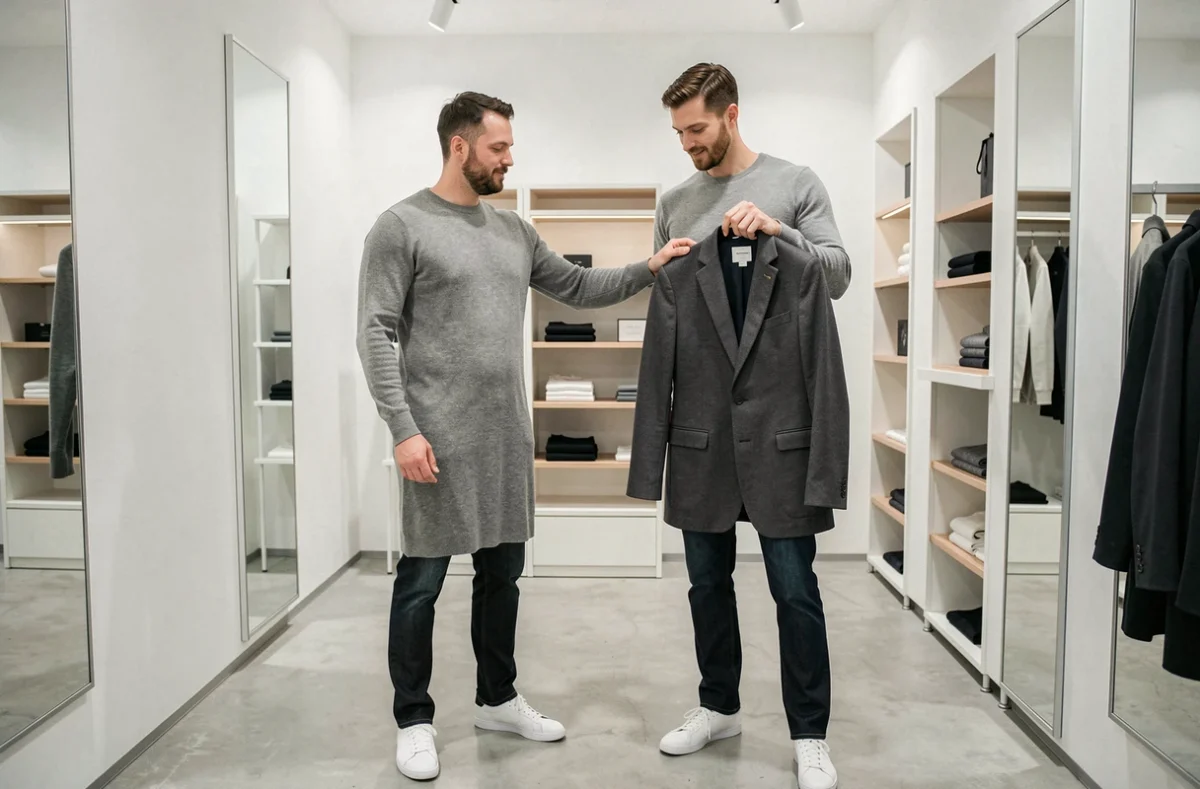
Alterations remain one of the most underrated tools. Having trousers adjusted or sleeves shortened costs little and can turn a garment that almost fits into one that fits perfectly. For men over 1.90 m, it’s often the difference between a look that works and one that makes it seem as though they’re wearing borrowed clothes.